

From October 13 to 18, 2025, Ukraine joined the global initiative #ErasmusDays2025, which annually brings together participants of the Erasmus+ Programme across Europe and the world.
This year’s campaign runs under the slogan “Live our values — Inspire the future,” emphasizing the importance of shared European principles — freedom, dignity, democracy, equality, rule of law, and human rights.
For the Ukrainian academic community, these values have a special meaning — they have become the foundation of daily work, resilience, and inspiration in the challenging conditions of wartime.
As part of ErasmusDays 2025, the Department of Applied Physics and Materials Science of Vasyl Stefanyk Carpathian National University held a thematic educational-scientific event entitled “Radiation in Space”, which brought together students, faculty, and young researchers interested in space physics, materials science, and radiation safety.
The event took place in a hybrid format — with more than 70 participants on-site and over 30 joining online.
The program included an interactive lecture delivered by Professor Volodymyr Kotsiubynsky, who, in an engaging and accessible manner, reviewed the physical mechanisms of cosmic radiation formation and propagation, its impact on living systems and materials, and modern technologies of radiation protection used in space missions.

Professor Volodymyr Troyansky from the Department of Physics and Astronomy focused his presentation on student training for space-related research, highlighting the new opportunities that are emerging with the development of the Astronomical Observatory on Mount Pip Ivan, which is becoming a powerful educational and research center in the Carpathian region.

The culmination of the program was a science show organized by Professor Volodymyra Boichuk and Associate Professor Liliya Turovska, where students observed demonstrations of physical phenomena related to radiation, luminescence, ionization, and protection effects.
The dynamic presentation style, interactive experiments, and opportunities for student participation made the event both exciting and educational for all attendees.
Such events play an important role in shaping students’ integrated understanding of interdisciplinary links between physics, materials science, biology, and space research.
They foster critical thinking, encourage scientific curiosity, broaden students’ worldviews, and motivate them to engage in international educational programs such as Erasmus+, which open pathways to academic growth and participation in global research networks.
The Department of Applied Physics and Materials Science of Carpathian National University is an active participant in several international Erasmus+ projects, including two large-scale initiatives:
- RISE-UP (Radiation Safety: European-Ukrainian Approach) — a Jean Monnet Module (ERASMUS-JMO-2023-HEI-TCH-RSCH, No.101127143) aimed at promoting EU policy in the field of radiation safety and the development of “green” nuclear energy.
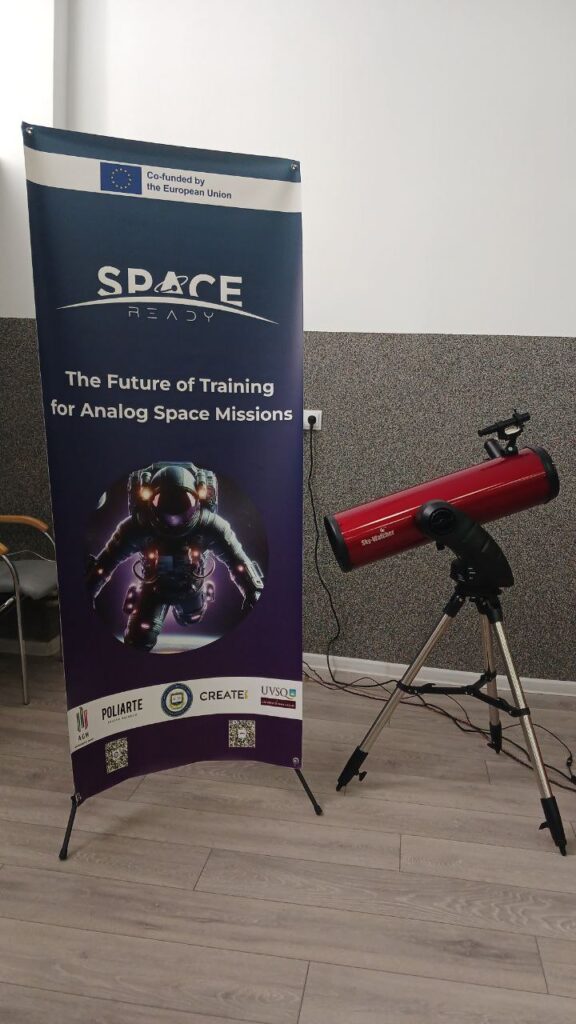
The project seeks to enhance the quality of training for radiation safety specialists, develop multidisciplinary competencies in line with EU standards, and create open online courses for students and professionals in the framework of lifelong learning. - SPACE_READY (Space-Ready e-Learning for Analog Astronauts) — an international educational project designed to create an e-learning course for training students, researchers, and managers of analog space missions.
The project is coordinated by the AGH University of Krakow (Poland), with partners including Vasyl Stefanyk Carpathian National University (Ukraine), Université de Versailles Saint-Quentin-en-Yvelines (France), Poliarte Academy of Design (Italy), and CreateHub (Poland).
The project will result in a unified curriculum for analog space missions, a digital e-learning course, and the training of instructors for implementation across EU and Ukrainian universities.
During #ErasmusDays2025, the Department of Applied Physics and Materials Science once again demonstrated that participation in the Erasmus+ Programme is not only about academic mobility — it is about embracing European values, fostering a culture of openness, partnership, and mutual support.
Thanks to such initiatives, a new generation of young researchers is being formed — individuals who can think globally, act responsibly, and shape the future of Ukraine within the united European family.
