

On 29 October at Carpathian National University (CNU) a roundtable gathered the RIFF project coordinators and representatives of CNU’s research infrastructures to discuss recovery-oriented road-mapping for Ukrainian RIs and the practical uptake of Open Science. Guests included Ondřej Gradil, Head of Research Infrastructure at Masaryk University and coordinator of RIFF; Ricardo Miguéis, Head of the Brussels Office of Portugal’s largest RTO (INESC) and a researcher with 20 years’ experience; and Liudmyla Tautieieva, policy analyst for the OECD, UNECE and the Centre for Innovation Systems of the European Future.

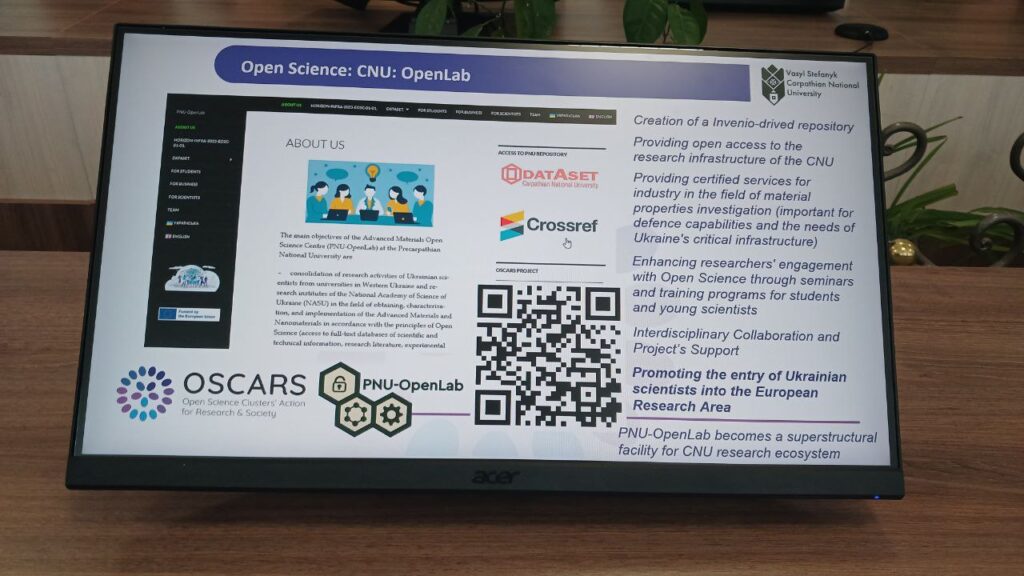
Presenting “Open Science & FAIR at CNU: From Policy to Practice,” OSCARS PNU-OpenLab coordinator Prof. Volodymyr Kotsyubynskyi showcased CNU’s ecosystem: the CNU-OpenLab programme and the multidisciplinary DataSet institutional repository built on InvenioRDM; the in-house software that converts InvenioRDM metadata to Crossref-ready XML (to be shared under the MIT License); open access to PNU-NanoLab facilities for collaborative research with data deposition and DOI assignment; citizen-science cooperation with SaveDnipro (e.g., the radiation station on Mount Pip Ivan); national capabilities such as the Mössbauer spectroscopy lab; two Diamond Open Access Scopus journals; and the university’s COARA-aligned assessment model (70% qualitative excellence/impact/implementation, 30% quantitative metrics).

The discussion highlighted how RIFF’s ESFRI-style peer-reviewed roadmap, combining bottom-up calls and top-down consultations, complements CNU’s OSCARS-backed actions that connect Ukrainian RIs with the European Research Area through Community-based Competence Centres and Composable Open Data and Analysis Services, training for RI managers, and mobility/knowledge-exchange schemes. Participants underlined that Open Science is not a slogan but critical infrastructure for Ukraine: it accelerates rebuilding and resilience, enables trustworthy, reusable data for energy, environment and security challenges, lowers duplication costs amid constrained budgets, strengthens international collaboration and visibility, and equips the next generation of Ukrainian scientists and engineers with FAIR-by-design practices that turn research into real-world solutions.
